SecuRAX — Unified Architecture
Status: 🟢 Built. The single-host estate described here runs today; the full end state is in doc 59. What the lights mean
Where this is heading
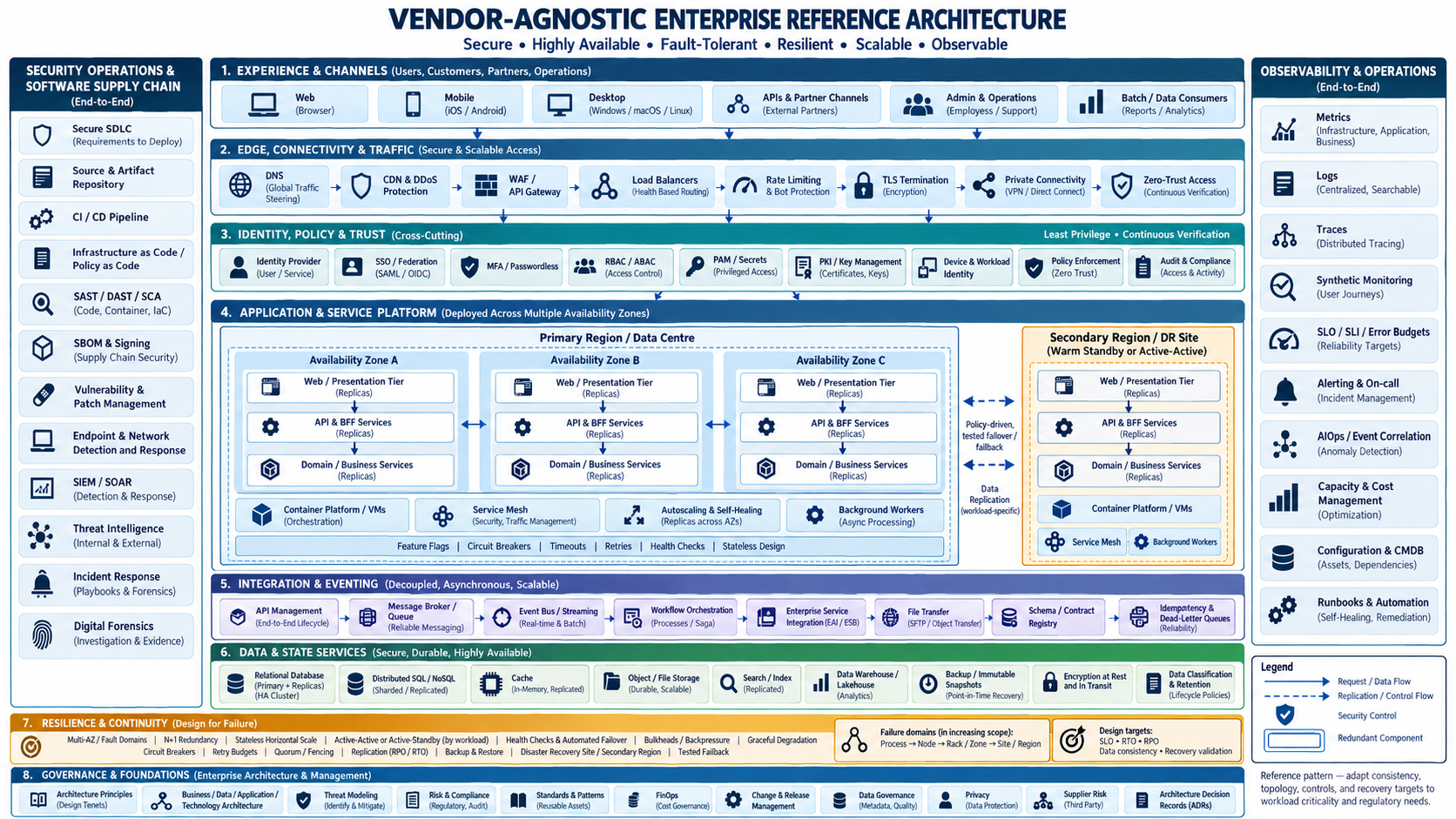
The full end state, with a light on every box and the order to build them in: doc 59.
One estate, five pillars, one shared spine. The spine is what prevents five disconnected projects: common identity, common data-classification, common policy-as-code, common observability, common audit trail. Everything plugs into that spine through open interfaces (Principle P-2), so any single component is swappable.
1. Layered reference architecture (TOGAF-style, bottom-up)
┌──────────────────────────────────────────────────────────────────────────────┐
│  L6 · EXPERIENCE        Portal UI · Guiding-Map PWA · dashboards · chat         │  ← humans
├──────────────────────────────────────────────────────────────────────────────┤
│  L5 · INTELLIGENCE      Hybrid LLM brain (local Ollama ↔ cloud) · agents ·      │
│                         guardrail gateway (PEP) · AI-SOC triage · RAG           │
├──────────────────────────────────────────────────────────────────────────────┤
│  L4 · AUTOMATION        n8n workflows · CI/CD · policy-as-code · IaC            │
├──────────────────────────────────────────────────────────────────────────────┤
│  L3 · SECURITY SERVICES SIEM · CTI · SOAR/IR · IDS/IPS · vuln-mgmt · CSPM/DSPM  │
├──────────────────────────────────────────────────────────────────────────────┤
│  L2 · DATA & KNOWLEDGE  PostgreSQL · object store · vector DB · Obsidian vault  │
├──────────────────────────────────────────────────────────────────────────────┤
│  L1 · PLATFORM          Docker Compose → Kubernetes (k3s/kind→EKS/GKE/AKS)      │
├──────────────────────────────────────────────────────────────────────────────┤
│  L0 · FOUNDATION SPINE  Identity (OIDC/SAML) · Secrets (Vault) · Data tiers ·   │
│                         Observability (OTel) · Audit trail · Backup (3-2-1)     │
└──────────────────────────────────────────────────────────────────────────────┘
      Legend: PEP = Policy Enforcement Point · OTel = OpenTelemetry · IaC = Infrastructure as Code
2. The five pillars on the shared spine
                         ┌───────────────── L0 SHARED SPINE ─────────────────┐
                         │ identity · secrets · data-tiers · audit · OTel      │
                         └───▲────────▲────────▲────────▲────────▲────────────┘
                             │        │        │        │        │
                    ┌────────┴──┐ ┌───┴────┐ ┌─┴──────┐ ┌┴───────┐ ┌┴─────────┐
                    │ P1 AI-Sec │ │ P2 AI- │ │ P3 SEN-│ │ P4 Life│ │ P5 GRC   │
                    │   Range   │ │   SOC  │ │  TINEL │ │  -OS   │ │ (proof)  │
                    │ guardrails│ │ detect │ │ brain  │ │ human  │ │ controls │
                    │ red-team  │ │ CTI/IR │ │ +auto  │ │ +OPSEC │ │ +audit   │
                    └───────────┘ └────────┘ └────────┘ └────────┘ └──────────┘
3. Data classification — the Red / Yellow / Green model (the router's law)
Nothing moves until it is classified. This is the single most important control for a person who protects banking-grade data; it is enforced before any processing (Principle P-4).
| Tier | Meaning | Routing rule | Examples |
|---|---|---|---|
| 🔴 Red | Restricted | Local models / on-prem only. Never leaves the machine. | Customer data, internal IPs, incident details, bank architecture, Aadhaar/PAN |
| 🟡 Yellow | Internal | Local preferred; cloud only after sanitisation (entity masking/redaction) | Security procedures, non-attributed analysis, career plans with employer context |
| 🟢 Green | General | Cloud AI acceptable | Public threat intel, certification study, general drafting |
The data-tier router (an automation/n8n node + the guardrail gateway) classifies each request, masks sensitive entities with format-preserving redaction when needed, routes to the correct model, and de-masks the response locally before it reaches you.
4. Design patterns in use (named, so the structure is predictable — Principle P-5)
| Pattern | Where | Why |
|---|---|---|
| Policy Enforcement Point (PEP) | apps/llm-gateway |
One choke-point enforces policy on all AI traffic |
| Strategy | providers.py, model router |
Swap detectors/models/clouds without touching callers |
| Adapter | tool/detector adapters | Wrap heterogeneous tools behind one interface |
| Pipeline | ingest → classify → route → act | Clear, testable stages for data flow |
| Circuit-Breaker | FAIL_MODE=closed |
Fail safe when a dependency is down |
| Sidecar | observability/log shippers | Cross-cutting concerns without app changes |
| Policy-as-Code | OPA/Conftest, Kyverno | Governance is version-controlled and testable |
| Event-driven correlation | ai-soc/ |
Telemetry → incidents, decoupled producers/consumers |
5. How the existing repo maps onto this architecture (nothing is wasted)
| Architecture element | Already implemented in |
|---|---|
| L5 guardrail gateway (PEP) | apps/llm-gateway/ |
| L5 AI-SOC triage | ai-soc/ |
| L3/L5 red-team & AI-SPM | redteam/ |
| L4 automation & CI/CD | .github/workflows/, local/scripts/ |
| L1 platform (local) | local/compose/, local/k8s/ |
| L1 platform (cloud) | infra/terraform/ |
| L0 governance/audit | governance/, docs/compliance-matrix.md |
| P4 human layer | personal-rnd/, Guiding-Map PWA |
6. Scaling path (same estate, never rebuilt — Principle P-1/P-7)
Phase 0  Laptop (Docker Compose, Ollama, free tiers)                    ₹0
   │  trigger: need HA / always-on / family access
Phase 1  Mini-PC or home server (32–64 GB), laptop becomes a client     one-time HW
   │  trigger: remote access / multi-device / client pilot
Phase 2  Single cloud VM + managed Postgres + object store              pay-as-you-go
   │  trigger: multiple workloads / need orchestration
Phase 3  Kubernetes (k3s on-prem or EKS/GKE/AKS), GitOps (Argo CD)      elastic
   │  trigger: multiple clients / tenants (MSSP)
Phase 4  Multi-tenant MSSP: per-tenant isolation, SSO, billing, SLAs    revenue-funded
05-ROADMAP.md; you never migrate
before the trigger fires.