SecuRAX — Enterprise Architecture alignment (the end-state blueprint)
Status: 🟡 Partly built. The target architecture; the seed runs today. Lights per capability in doc 59. What the lights mean
Where this is heading
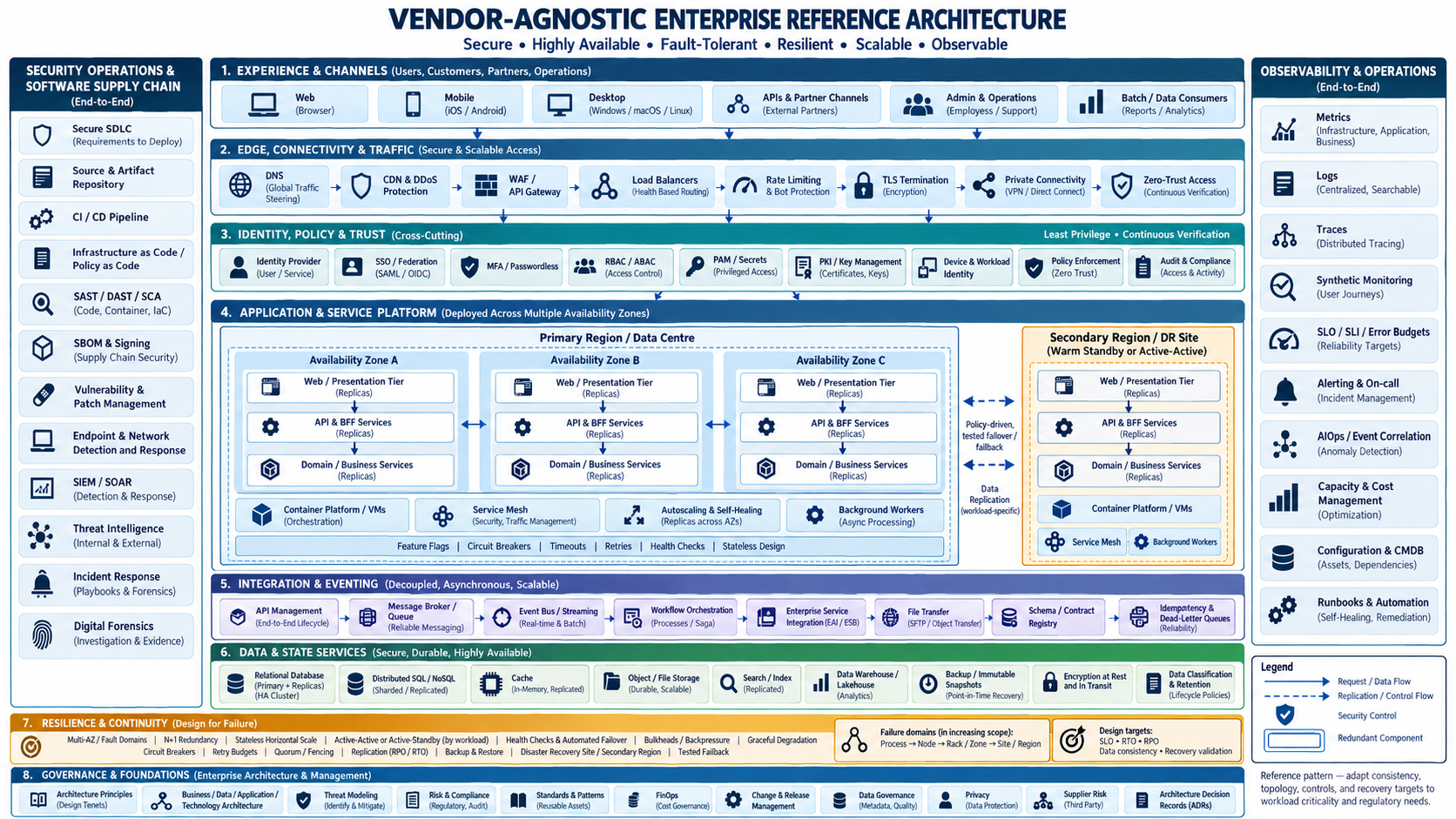
The full end state, with a light on every box and the order to build them in: doc 59.
This is the target-state reference architecture every current and future SecuRAX build must map to. It mirrors the layers of a world-class, vendor-agnostic enterprise architecture — secure, highly available, fault-tolerant, resilient, scalable, observable, AI-ready, data-mesh-enabled, ESG-aligned — and shows, layer by layer, what SecuRAX runs today (local-first), the end-state at scale, and the standard interface that lets components talk with zero friction and stay swappable. The one rule that keeps everything compatible:
Every component speaks an open standard behind a stable interface. Interfaces are the contract; implementations are swappable. A new build that honours the interface plugs into the end-state with no rework — that is how we avoid lock-in and integration friction.
The invariant interfaces (the "contract" — memorise these)
| Concern | Standard interface | Why it removes friction |
|---|---|---|
| AI models | OpenAI-compatible (/v1/chat/completions) via LiteLLM |
any model (local/cloud/free) swaps without touching callers |
| Agents & tools | MCP (Model Context Protocol) | any client (Claude, local agent) drives any capability |
| Identity | OIDC / SAML, SCIM | one login plane; any IdP interchangeable |
| Secrets | Vault/OpenBao API | one secrets plane; no keys in code |
| Object storage | S3 API | MinIO ↔ cloud without code change |
| Telemetry | OpenTelemetry (OTel) | one pipe for metrics/logs/traces, any backend |
| Threat intel | STIX/TAXII | share/consume intel with any platform (CERT-In) |
| Services | OpenAPI + GraphQL federation/BFF | contract-first, independently deployable |
| Events/data | CloudEvents + a data-mesh contract (schema + lineage) | decoupled producers/consumers, self-serve data |
| Policy | policy-as-code (OPA/Rego, Kyverno) | one way to express/enforce rules everywhere |
Layer-by-layer map (image → SecuRAX today → end-state)
1. Experience & Channels — today: Guiding Map PWA (the cockpit), MCP clients, CLI, APIs. end-state: + voice/multimodal agents, partner APIs, batch/data consumers. interface: PWA/OpenAPI/MCP.
2. Edge, Connectivity & Traffic — today: local nginx + the guardrail gateway; Tailscale (zero-trust mesh) as the private edge. end-state: DNS/CDN/WAF + API gateway, load balancers, rate limiting, 5G/MEC far/near edge for local inference. interface: HTTP + WireGuard; WAF/API-gateway OpenAPI.
3. Identity, Policy & Trust — today: planned Keycloak (OIDC/SSO/MFA, RBAC/ABAC), OpenBao (PAM/secrets); assume-breach, least blast radius. end-state: + passwordless/passkeys, decentralized identity/SSI (VCs). interface: OIDC/SAML/SCIM + Vault API.
4. Application & Service Platform (+ AI/ML & Agentic AI) — today: the llm-gateway = Prompt-Engineering Gateway & Guardrails (PEP), MCP server = Agentic AI controller, LiteLLM = multi-model serving, Qdrant = vector DB/embeddings, assistant/+agents/ = agent layer, learning/ = RLHF-lite + ethical-AI/antifragility loop, model-registry = MLOps. end-state: multi-AZ web/app tiers, GraphQL federation/BFF, real-time inference, service mesh, autoscaling/self-healing, background workers. interface: OpenAI-compatible + MCP + OpenAPI.
5. Integration & Eventing — today: n8n glue + the MCP tool catalog. end-state: API marketplace & governance catalog, knowledge graph, federated data mesh & data products, data lakehouse, data lineage & catalog. interface: CloudEvents + OpenAPI + data-product contracts.
6. Data & State Services — today: PostgreSQL, MinIO (S3), restic backups, guardrail data classification (Red/Yellow/Green) + retention, encryption in transit/at rest. end-state: + distributed SQL/NoSQL, cache, search/index, immutable snapshots. interface: SQL + S3 + the classification policy.
7. Resilience & Continuity — today: the antifragility engine (failures→strengths), red-team suite, immutable Git ledger, HITL. end-state: automated chaos engineering, cyber-resilience/immutable backups, AI-governance & ethics board, ESG/GreenOps, automated FinOps (the LiteLLM budget cap is the seed). interface: chaos experiments-as-code; FinOps budget API.
8. Governance & Foundations — today: docs/securax/ (principles, operating model, compliance map), ADRs, threat modeling, policy-as-code (OPA/Conftest, Kyverno). end-state: full business/data/app/tech architecture, supplier-risk, privacy (DPDP), change/release. interface: ADRs + policy-as-code + the compliance map.
Observability & Operations (end-to-end) — today: gateway /metrics + /healthz, ./securax doctor, board report. end-state: Prometheus + Grafana + Loki + OTel, synthetic monitoring, SLO/SLI/error budgets, AIOps event correlation (the AI-SOC triage is the seed), capacity/cost & business-value observability. interface: OpenTelemetry.
End-state deep-dive: resilience, trust, supply-chain & data platform (image-8)
The layer map above is the skeleton; these are the cross-cutting concerns a holistic end-state must name explicitly so no future build silently omits them. Each row: what it means → SecuRAX today → end-state → the standard interface/tool. The rule stays the same — honour the interface and you plug into the end-state with no rework.
7a. Disaster recovery & business continuity
| Concern | Today (local-first) | End-state | Target / interface |
|---|---|---|---|
| RPO / RTO (how much data / time you can lose) | daily restic + dated JSON exports; estate-sync per-key merge | tiered: RPO ≤ 15 min (async replica), RTO ≤ 1 h (warm standby) | documented per data class; tested in DR drill |
| Secondary region / standby | single box; Export/Import is the manual DR | warm standby in a 2nd region/cloud; Postgres streaming replica; MinIO/S3 cross-region replication | S3 replication + Postgres WAL |
| Backups | restic snapshots, Git ledger (immutable history) | immutable/object-lock backups (ransomware-proof), tested restores, offline copy | S3 Object-Lock / WORM |
| Failback | re-import on the recovered box | documented, rehearsed failover and failback; no split-brain | runbook + the annual DR drill (roadmap) |
7b. Resilience patterns (fault isolation under load/failure)
| Pattern | Today | End-state |
|---|---|---|
| Fail-closed / timeouts | gateway + estate-sync fail-closed; per-fetch timeouts in the research agent | every dependency call bounded by a timeout + deadline budget |
| Bulkheads | per-service mem_limit/cpus in compose |
pool/quota isolation so one tenant/workload can't starve others |
| Backpressure & rate limiting | gateway RATE_LIMIT_PER_MIN; research agent step/page budgets |
queue depth limits + load-shedding at the API gateway |
| Circuit breakers & retry budgets | fail-closed on upstream error | breakers + jittered retries with a retry budget (no retry storms) |
| Graceful degradation | Guiding Map works offline; "AI warming up" status; local-first fallback | cached/last-known-good responses; read-only mode under partial outage |
| Idempotency & quorum/fencing | estate-sync per-key timestamp merge (safe re-push) | idempotency keys on writes; quorum + fencing tokens for leader actions |
7c. Trust, crypto & workload identity (PKI)
| Concern | Today | End-state | Interface |
|---|---|---|---|
| Secrets | .env (git-ignored), fail-closed if unset; no keys in code |
Vault/OpenBao with dynamic secrets + rotation | Vault API |
| Key management | TLS via the proxy; at-rest encryption assumed | KMS/HSM-backed keys, envelope encryption, rotation policy | KMS / PKCS#11 |
| Certificates / mTLS | Tailscale (WireGuard) private edge | internal PKI + mTLS service-to-service, short-lived certs, auto-renew | ACME / step-ca |
| Device & workload identity | device tokens (estate-sync), Tailscale node identity | SPIFFE/SPIRE workload IDs; passkeys for humans | SPIFFE SVID / OIDC |
7d. Software-supply-chain SecOps
| Concern | Today | End-state | Interface/tool |
|---|---|---|---|
| SBOM | CycloneDX SBOM generated in CI (container-scan) |
SBOM per artifact, stored + diffed; VEX for exploitability | CycloneDX / SPDX |
| Build provenance & signing | SHA-pinned actions; gitleaks/Semgrep/Trivy gates | Sigstore cosign signatures + SLSA provenance; verify-on-deploy | cosign / in-toto |
| Dependency & image risk | Trivy (vuln+secret+misconfig), Semgrep SAST | continuous advisories + auto-PRs; admission blocks unsigned/vulnerable images | Trivy / Kyverno |
| Runtime detection (EDR/NDR) | fail-closed guardrails; AI-SOC triage seed | Falco (runtime), NDR/flow logs → the AI-SOC triage → SIEM | Falco / OTel / STIX |
| IR & forensics | immutable Git ledger; antifragility ledger | IR runbooks, evidence capture, immutable audit, tabletop drills | the IR runbook set |
5a. Messaging & data-in-motion (decoupling at scale)
| Concern | Today | End-state | Interface |
|---|---|---|---|
| Broker / ESB | n8n glue + MCP tool catalog (synchronous) | durable message broker (NATS/Kafka/RabbitMQ) for async, replay | CloudEvents over the broker |
| Schema registry | JSON contracts in code + the compose/PII CI gates | a schema registry with compatibility checks (producer/consumer safety) | Avro/Protobuf/JSON-Schema registry |
| Delivery guarantees | estate-sync idempotent merge | idempotency keys + outbox pattern + DLQ (no lost/dup events) | DLQ + consumer offsets |
6a. Data platform (state at scale)
| Concern | Today | End-state | Interface |
|---|---|---|---|
| Cache | in-process; localStorage on the PWA | Redis/Valkey for session/result/rate-limit state | Redis protocol |
| Search / index | pattern matching; AnythingLLM vectors | OpenSearch/Meilisearch + the vector DB (hybrid search) | OpenSearch API |
| Warehouse / lakehouse | Postgres + JSON exports | DuckDB → ClickHouse/lakehouse, CDC from Postgres, data-mesh products | SQL + Iceberg/Parquet |
Ops excellence (run it like a service)
| Concern | Today | End-state |
|---|---|---|
| CMDB / asset inventory | capability catalog (doc 03) + AI-SPM inventory | a live CMDB fed by discovery; every asset owned + classified |
| Runbooks | ./securax doctor, DEPLOY/FREEZE notes |
a runbook per failure mode (DR, broker lag, cert expiry, key compromise) |
| Synthetic monitoring | /healthz, the PWA readiness ping |
external synthetic probes (user journeys) + SLO/SLI error budgets |
| Alerting & on-call | board report; red CI (Andon) | alert routing, on-call, incident timeline, blameless post-mortems (Hansei) |
Conformance rules — what every future build must satisfy
A build is "end-state-compatible" only if it ticks these (keep this as the PR checklist): 1. Speaks a standard interface from the table above — never a bespoke protocol. 2. Local-first & swappable — works offline/sovereign by default; cloud is opt-in and capped. 3. Guarded — any AI path goes through the gateway (PEP); any data respects Red/Yellow/Green. 4. Observable — emits health + metrics (OTel-ready); failures are capturable by the antifragility ledger. 5. Governed — policy-as-code where it enforces a rule; an ADR when it makes an architectural choice. 6. No single point of failure — a swappable alternative exists (capability catalog, Principle P-2). 7. Least blast radius / zero-trust — least privilege, private by default (Tailscale), assume breach. 8. Resilient under failure — every dependency call is bounded (timeout + retry budget), fails closed or degrades gracefully; writes are idempotent; no new single point of failure (rule 6). 9. Recoverable — its state is covered by a backup with a known RPO/RTO and a tested restore; nothing lives only in a container's writable layer. 10. Supply-chain clean — pinned deps, passes the SBOM + gitleaks + Semgrep + Trivy gates; a runtime artifact is signed/verifiable at the end-state (cosign/SLSA). 11. Operable — ships a health/synthetic check and, for a failure mode it introduces, a runbook line; emits enough telemetry to alert on (OTel). 12. Tested from every angle — see below.
Continuous improvement + multi-perspective testing (the Kaizen discipline)
Borrowing the best time-tested methods — Toyota Kaizen / Jidoka / Poka-yoke / Andon, German Gründlichkeit (thoroughness) and the Swiss-cheese defence-in-depth model — every change is reviewed from all tester perspectives before it ships:
| Perspective | The question it asks | Where it runs |
|---|---|---|
| Functional | does it do what it should? | unit/behaviour tests (pytest, jsdom) |
| Security | can it be abused / leak data? | guardrails, red-team suite, PII/secret gate, gitleaks, Semgrep, Trivy |
| Reliability | what happens when a dependency fails? | fail-closed design, integrity guards, (end-state) chaos engineering |
| Performance | is it frugal with CPU/RAM/disk/tokens? | resource caps, LiteLLM budget, ./securax doctor |
| Usability | can a non-expert use it without friction? | inline help, example seeds, the "one screen" test |
| Data/privacy | is PII classified and contained? | Red/Yellow/Green, DPDP alignment, the PII gate |
| Maintainability | will the next person (or you in a year) understand it? | ADRs, comments, the FREEZE "subtract" rule |
- Poka-yoke (mistake-proofing): CI gates make the wrong thing hard — the PII gate blocks a secret before it merges; the build-drift guard blocks a stale single-file build.
- Jidoka (stop-the-line) + Andon: a red CI gate stops the merge and surfaces the exact defect.
- Kaizen: every failure becomes a permanent strength via
learning/(the antifragility score only goes up); every friction you hit becomes the next inline guide or the next capability. - Hansei (reflection): the After-Action Review and Sunday Pulse in the cockpit apply the same reflect-and-improve loop to you, not just the code.
One line: standard interfaces keep the pieces compatible; the multi-perspective gates keep each piece correct; Kaizen keeps the whole thing getting better — so the end-state is reached by compounding small, verified steps, never a risky big-bang.